

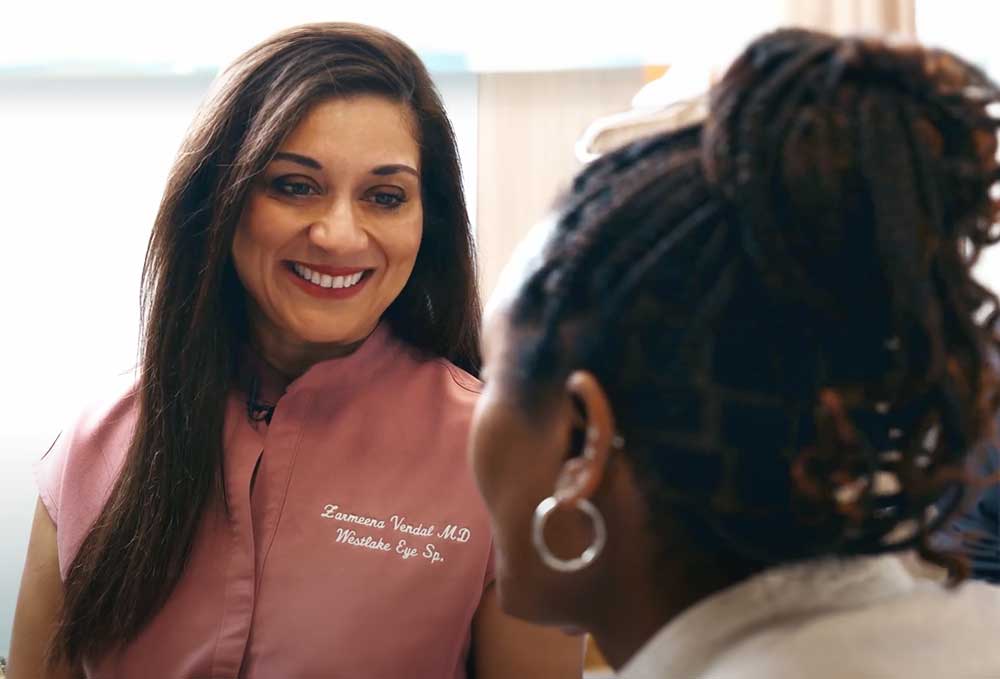
With insights from Dr. Zarmeena Vendal, MD (Harvard-trained glaucoma specialist at Westlake Eye Specialists)
Glaucoma can quietly damage vision for years before you notice anything is wrong. In fact, early glaucoma often has no symptoms, which is why about half of people with glaucoma don’t know they have it.
At Westlake Eye Specialists, Dr. Zarmeena Vendal, MD—a board-certified ophthalmologist, Harvard fellowship-trained glaucoma specialist, and founder/medical director of Westlake Eye Specialists—focuses on a simple goal: identify glaucoma earlier, intervene appropriately sooner, and help patients protect vision for life.
This patient-focused guide is based on Dr. Vendal’s recent article, “Closing the Gap Between Glaucoma Diagnosis and Intervention,” where she emphasizes that timely, evidence-based procedural options can help preserve vision long-term—and that patients are often more open to these options than physicians assume.
Why “watching and waiting” can be risky with glaucoma
Glaucoma is not a condition where you want to “feel it out.” Because vision changes can be subtle at first (and permanent once they occur), the biggest opportunity is before noticeable vision loss.
Dr. Vendal’s message is clear: when glaucoma is detected early, and the plan includes evidence-based intervention—including options like SLT laser, procedural pharmaceuticals, and MIGS—patients can have a better chance of maintaining functional vision throughout life.
In Austin, that matters because busy schedules, long commutes, and “I feel fine” thinking can easily delay follow-up. The reality: glaucoma outcomes improve when care is consistent and proactive.
Dr. Vendal’s Austin approach: patient clarity + modern options
One reason patients delay treatment is that glaucoma can feel abstract—numbers, scans, and “risk.” Dr. Vendal’s style is to bring glaucoma down to something you can understand and act on: what your testing shows, what your risk profile is, and what plan is most realistic for your life.
On Westlake’s site, Dr. Vendal is described as:
- Harvard Medical School / Massachusetts Eye and Ear fellowship-trained in glaucoma
- Voted Austin Top Doc by peers (listed years on the site)
- An early adopter/leader in minimally invasive glaucoma procedures in the Austin area (as described in her bio)
That combination—deep specialty training plus a practical, patient-centered mindset—is exactly what glaucoma patients need: not just diagnosis, but a plan that actually gets done.
The real “gap” patients experience: diagnosis without follow-through
Many patients hear one of these phrases and aren’t sure what it means next:
- “You’re a glaucoma suspect.”
- “Your eye pressure is high.”
- “Your optic nerve looks suspicious.”
- “We’ll monitor it.”
Monitoring can be appropriate—but only when it’s structured and intentional. The gap Dr. Vendal calls out is the space where patients get labeled, but don’t receive timely intervention that matches the risk. Her conclusion: our job is to close the gap between diagnosis and intervention.
What “early intervention” may look like (in plain English)
Treatment is individualized, but modern glaucoma care is no longer “drops only.” Dr. Vendal specifically highlights evidence-based procedural approaches such as:
SLT (Selective Laser Trabeculoplasty)
A common in-office laser option that can reduce eye pressure and, for many patients, reduce reliance on daily drops—helpful for real-world adherence.
Procedural pharmaceuticals
Therapies designed to reduce the day-to-day burden of drops and improve consistency of pressure control over time.
MIGS (Minimally Invasive Glaucoma Surgery)
Micro-invasive procedures that can be considered in appropriate patients, often alongside cataract surgery, to improve fluid outflow and lower IOP with a favorable safety profile.
Bottom line: there are more options than most patients realize—and many are designed specifically to make treatment easier to stick with.
Bonus: Dr. Vendal’s work for “active” glaucoma patients who want great vision after cataract surgery
Many Austin-area patients with mild glaucoma aren’t just trying to “avoid blindness someday.” They’re active and want quality of vision now—driving at night, screens, golf, and as much glasses-independence as is safely possible.
In a separate recent feature tied to her ASCRS presentation, Dr. Vendal discusses evaluating violet light-filtering EDOF IOL technology in glaucoma suspects and mild primary open-angle glaucoma patients, motivated by real issues like contrast sensitivity and nighttime visual quality.
If you’ve been told you have mild glaucoma and you’re considering cataract surgery, this is exactly the kind of nuance you want in your surgeon: someone thinking not only about the cataract, but how lens choice can interact with glaucoma-related visual quality.
When should you see an Austin glaucoma specialist?
You should consider scheduling a glaucoma evaluation if:
- You’ve been told you have high eye pressure or ocular hypertension
- You were labeled a glaucoma suspect
- You have a family history of glaucoma
- You’re overdue for follow-up (especially if you had an abnormal OCT or visual field)
- You want a second opinion on whether it’s time to move beyond “just watching”
Remember: early glaucoma often has no symptoms, and “feeling fine” doesn’t equal “no progression.”
The Westlake Eye Specialists promise: proactive glaucoma care for Central Texas
Dr. Vendal’s perspective is patient-forward and action-oriented: detect earlier, educate clearly, and intervene with the right evidence-based tools at the right time—so patients have the best chance to preserve vision for decades.
If you’re looking for an Austin glaucoma specialist, Westlake Eye Specialists offers comprehensive testing and modern treatment options guided by Dr. Vendal’s experience and specialty training.
Medical disclaimer: This content is for general education and is not medical advice. Diagnosis and treatment are individualized.